Trans advocates ask City Council to step up protections
Before he made the violent threats that sparked viral social media posts, ignited local concerns about violent, anti-trans rhetoric and led a dozen to speak at the Lansing City Council last week …
Threats at local bar fuel community concern amid continued federal attacks
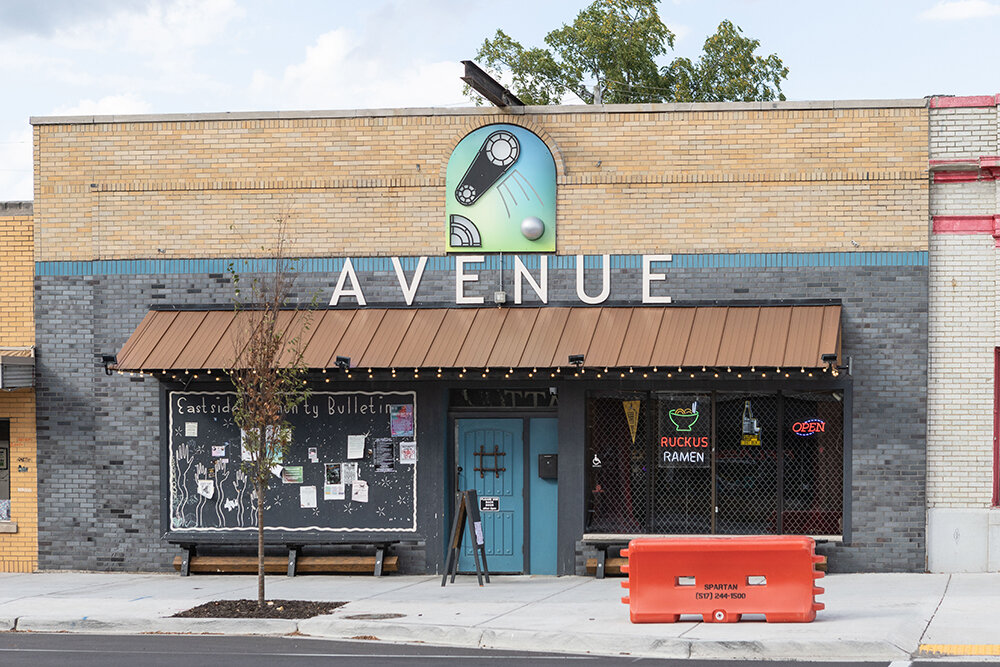
Before he made the violent threats that sparked viral social media posts, ignited local concerns about violent, anti-trans rhetoric and led a dozen to speak at the Lansing City Council last week about threats to the trans community, a man outside the Avenue Cafe approached a group with a simple request.
“He came up and asked the group if anyone had a lighter,” said one of the two women directly threatened, who spoke on the condition of anonymity. “And I did have a lighter, so I gave it to him.”
The man said he had come out “to gauge the energy on the Charlie Kirk shooting,” she said. Kirk, a prominent right-wing influencer who repeatedly espoused anti-gay and anti-trans views, was assassinated last month.
“No one took that bait,” she said, but the man continued to elaborate on his self-proclaimed “fascist” views. At first, she was “fascinated” to learn more about his opinions. But after another person joined the debate and disparaged Kirk, the man’s tone changed.
“Immediately, he’s like, ‘So you think that Charlie Kirk deserved to die, and therefore I have the right to kill all of you right now.’”
The man doubled down, his threats becoming more direct as he alluded to “something big” happening as a result of Kirk’s assassination, according to multiple sources present.
He was eventually kicked out.
The news proliferated through social media. A TikTok video detailing the incident accumulated 200,000 views.
At last week’s City Council meeting, more than a dozen people asked for support and action from Councilmembers amid an uptick in anti-trans rhetoric fueled by the federal government.
“This is traumatizing, this is intimidation and this is terror,” said Jasper Baldwin, who said he was part of the group approached by the man. “My friends now feel unsafe in this city. We all have struggles outside of these threats, and our safe spaces are being threatened too.”
The Avenue, while not formally a gay bar, is a popular space for Lansing’s younger queer and trans community. Trans and nonbinary pride flags hang inside.
“Many of the people I hold close and love in some way are part of this community, and the uptick in violence against trans people is only a small part of the issues this community is facing,” Baldwin said. “As a cis white man-presenting, I want to know that our Council is going to protect my loved ones and not just me.”
Maya — City Pulse is withholding last names of trans speakers — struck a more direct tone.
“Do you have people you care about who are becoming scared or concerned?” they asked Councilmembers. “Do you participate in the local community to discover what we need and how we feel? Or do you only interact with your constituents from across this podium?”
Maya referenced racist, antisemitic and homophobic graffiti that was painted in Old Town in July as well as “white supremacists” who recorded customers at queer-friendly coffee shop Strange Matter.
“I want to see a public statement about the transphobic violence we’ve seen in Lansing over the summer lately,” they said. “I want explanations for why my homeless trans siblings are being targeted by this government and this police force more than fascist terrorists, white supremacists.”
Isidor discussed the struggle they experienced as a nonbinary person working in the city’s sustainability office, where they said they “became aware of an internal culture of disrespect to those who do not fit in the exact mold of society’s expectations.” Isidor said coworkers made no attempt to use their appropriate pronouns and spoke disparagingly about the city’s homeless and poor residents.
“When you are constantly being misgendered with no active attempts to learn how to correct that behavior and continually being viewed in a way that does not align with how you see yourself, over time the constant disrespect of not even trying wears on you,” they said.
“My question to you is, how are we to expect the city to proactively do the work that is necessary to protect the most vulnerable communities, when the city’s own employees do not even see the people who live here as humans, the people they’re serving?”
Atula evoked the looting of Magnus Hirschfeld’s Institute of Sexology in 1933, which was carried out by Nazi-supporting youth, not government agents.
“You might think it was done by the government, but it wasn’t,” she said. “It was done by a student union who was allowed to do this through state inaction. So, what I really want to emphasize is that we should keep these mistakes as historical mistakes and not repeat them.”
“I understand that the city of Lansing is not the state government,” said Lindsey. “It’s certainly not the federal government. Maybe you feel your hands are tied and that there’s nothing you can do. It still remains to say that this is fucking insane, what is happening.”
Khadja Erickson, executive director of the Mid-Michigan Tenant Resource Center, spoke about the city’s clearing of a Dietrich Park homeless encampment as well as anti-trans attacks, tying both to federal rhetoric.
“We are living in a time when Donald Trump openly celebrates cruelty against immigrants, against queer and trans people, against the poor,” she said.
Anti-trans rhetoric from the Trump administration dates back to his election in 2016, but his second administration has cracked down hard on trans rights. Within a month of taking office, President Trump had signed five executive orders specifically targeting transgender people.
Those orders removed Title IX protections for transgender people in schools, revoked the ability to change gender markers on federal documentation, banned transgender people from the military, banned gender-affirming care for minors and 18-year-old adults and far more. References to transgender people were scrubbed from many government websites.
But that rhetoric has been taken a step further in the wake of two recent tragedies. Kirk’s alleged assassin is a cisgender man, but his roommate is reportedly a transgender woman. Media outlets including The Wall Street Journal reported that the ammunition used in the attack was engraved with pro-trans messages, which turned out to be false. The perpetrator’s partner cooperated with authorities and is not known to have been involved. Weeks earlier, Robin Westman, who at least at one point identified as transgender, killed three and injured 21 in a shooting at a Minneapolis Catholic church.
There is no evidence to support the assertion that transgender mass shooters are on the rise. Mark Bryant, executive director of the Gun Violence Archive, told FactCheck.org after the incidents there have been five confirmed transgender mass shooters since 2013 — out of over 5,700 total incidents. Around 1% of the U.S. population identifies as transgender, according to a statistical model by UCLA’s Williams Institute, meaning transgender people are less likely than average to perpetrate such crimes.
That hasn’t stopped the federal government from capitalizing on the incidents. Major outlets reported in early September, before Kirk’s shooting, that the Justice Department was considering restricting transgender gun ownership. After the shooting, Trump posted a Twitter/X poll asking, “What’s the greatest domestic terror threat facing America?” with the options “ANTIFA,” “TRANTIFA” and “They’re the same thing.” Other administration officials supported the theory.
Then the conservative Washington think tank Heritage Foundation released a proposal to designate “Transgender Ideology-Inspired Violence and Extremism” as a domestic terrorism designation. Independent journalist Ken Klippenstein reported that the FBI was considering treating transgender suspects as a subset of “nihilistic violent extremism.” Late last month, Trump signed a national security directive that directed defense and law enforcement to consider “extremism on migration, race and gender” as an indicator of a “pattern of violent and terroristic activities.”
The attacks put a strain on transgender people, who multiple studies show are far more likely to be on the receiving end of violence.
At the end of the meeting, Councilmember Brian T. Jackson, who chairs the Council’s Equity, Diversity & Inclusion Committee, announced a city meeting to discuss solutions to the issue at 4:30 p.m. today (Oct. 8).
“We hear you loud and clear, and I do agree that you should not be terrorized in your city and that there should be a forum available,” he said.
Jackson said the police have been invited. The Lansing Advocates for Trans Safety, a newly formed group including many of the people who spoke at the Council meeting, have since asked police not to be included because some trans community members may feel unsafe around officers.
Mayor Andy Schor will not attend, city spokesperson Scott Bean said.
“The chair asked for a staff member to attend and just listen,” Bean said.
“We’ll at least have a discussion first to hear and talk about solutions, because I can’t pretend like I know what the solutions are,” Jackson said at the Council meeting. “I could think of some, but that wouldn’t make sense without a discussion. So, let’s have that.”