Masterpiece in the parole office
The mid-October sun stole past the blinds of the Ingham County Parole Office on Lansing’s south side. Martín Vargas sat silently in a hard chair, his back to the window, making use of …
Artist Martín Vargas paints a parolee’s torturous journey
The mid-October sun stole past the blinds of the Ingham County Parole Office on Lansing’s south side. Martín Vargas sat silently in a hard chair, his back to the window, making use of the valuable afternoon light. There were scraps of paper on his lap and paints and brushes on the chair next to him. A ladder was set up nearby.
Vargas was immersed so deeply in a well of focus that a visitor to the office, perhaps on the way to a nerve-wracking meeting with a parole officer, could easily walk past him to the inner door without noticing he was there.
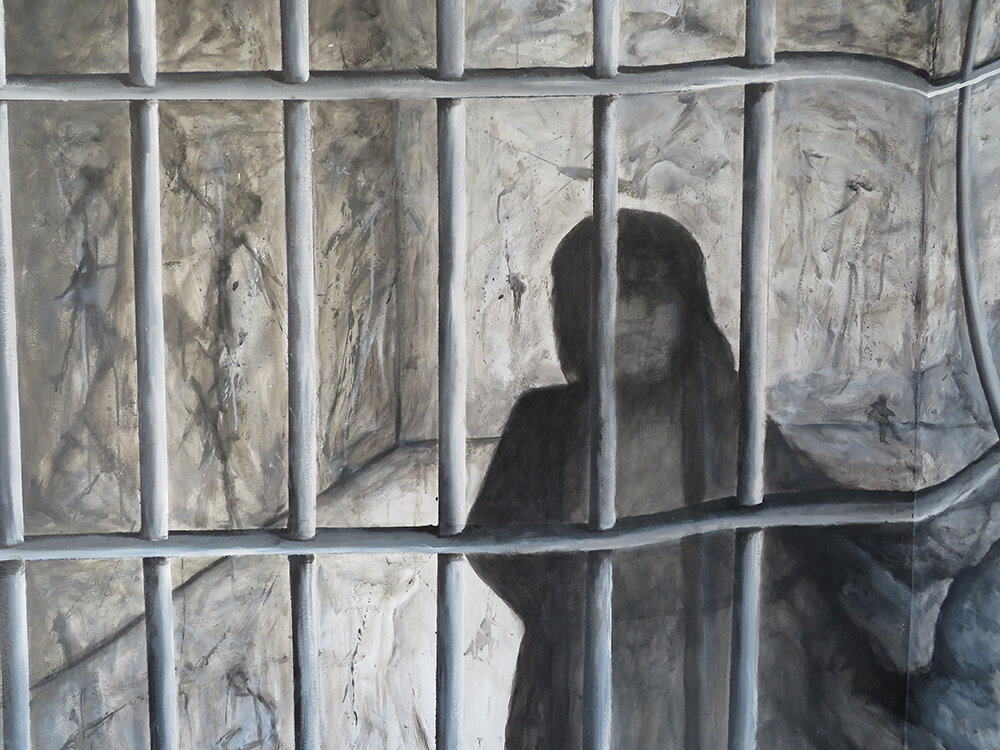
But the art on the wall was impossible to miss.
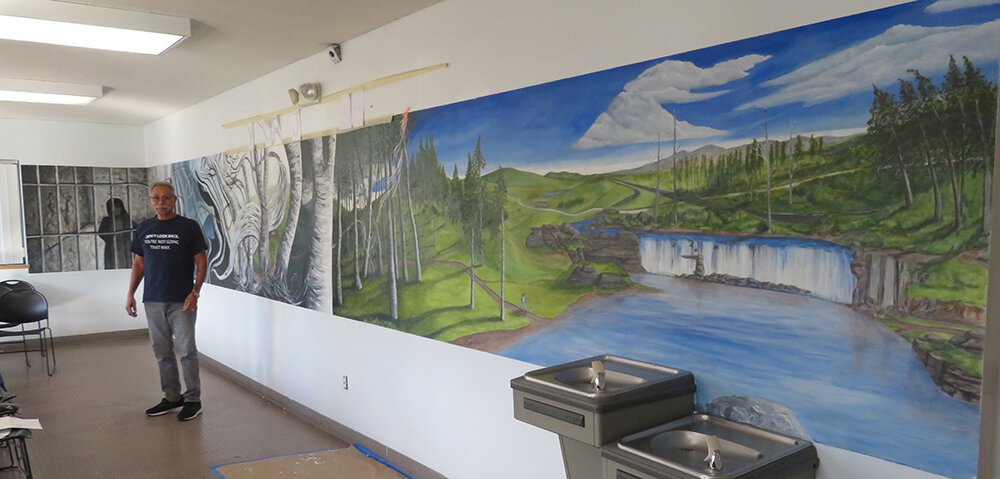
On Oct. 15, Vargas finished a 34-foot-long, multilayered vision, full of tiny details and sweeping symbolism, that dramatizes the parolee’s journey from bleak, gray-walled prison to bright, blue-sky paradise.
In the past three months, parole office supervisor Abigail Callejas watched the mural take shape.
Every day, she came into the lobby and teased Vargas with the same question: “Aren’t you finished yet?” (According to Vargas, she started doing that on the first day.)
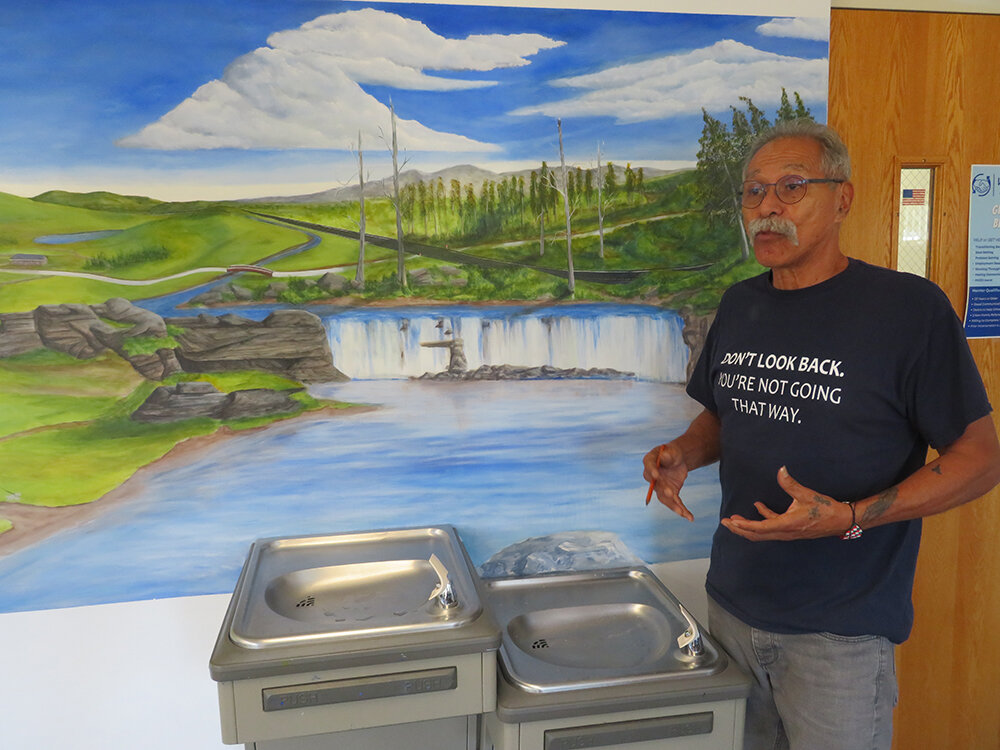
Today, it really was finished. The only thing left to do was sign it and add the title letters Vargas was sketching out on his lap: “Your Journey.”
“It’s beautiful,” Callejas said.
In June 2025, state Department of Corrections staff discussed ways to make their bare-bones offices more inviting. The project quickly grew into something more personal. Vargas, 71, was sent to prison at 17 and lived out the journey from darkness to light that he passionately poured into his mural.
“The goal wasn’t just to put a commercial picture here and there,” Callejas said. “We wanted to celebrate people coming back, being released into the community, and show what they can do.”
The project has won Vargas a lot of new fans, including Steven Bridges, senior curator at the MSU Broad Art Museum. Bridges worked with Vargas several years ago for an exhibit of art by incarcerated people. At Vargas’ invitation, he attended a September event for parolees at the south Lansing office and was floored by what he saw.
Bridges described the mural as “moving and poignant and incredibly impactful, yet done in a quiet and understated way.”
“I was captivated by the work and his artistic vision,” Bridges said. “It transforms that space into one of healing and recovery.”
‘Nothing is solid’
Vargas moves with a sense of quiet purpose and conserves his energy for things that matter.
One of his favorite words is “avoid.”
Avoid trouble.
Avoid drawing too much attention to yourself.
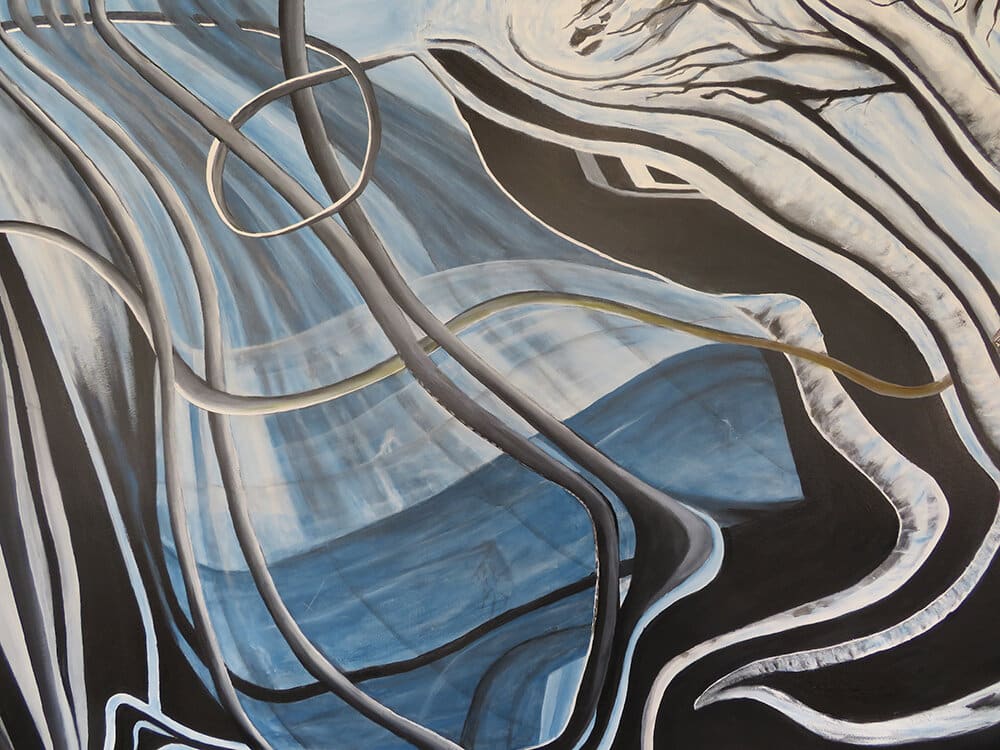
But when he stood in front of the turbulent heart of the mural, the middle section, his passion outran his caution. He grabbed a pen and traced a web of prison bars bending, spiraling, morphing and melting.
“This is the re-entry phase of you coming out of prison,” he said. “Nothing is solid. It isn’t stable. You need home placement. You have to go through parole programs, and if you don’t …”
Some of the bars curve back, as if pulled by dark gravity, toward the murk of the prison cell at the far left of the mural.
“… you go back there again.”
While painting the mural this summer and fall, Vargas saw people enter the office, disappear inside the back room and come back into the lobby in handcuffs.
“They go back to prison because they violated parole,” he said. “This phase goes so fast, and if you don’t watch your step, you can end up in chains.”
Vargas calls his style “photorealistic,” and in this section of the mural, he somehow managed to photograph a nightmare.
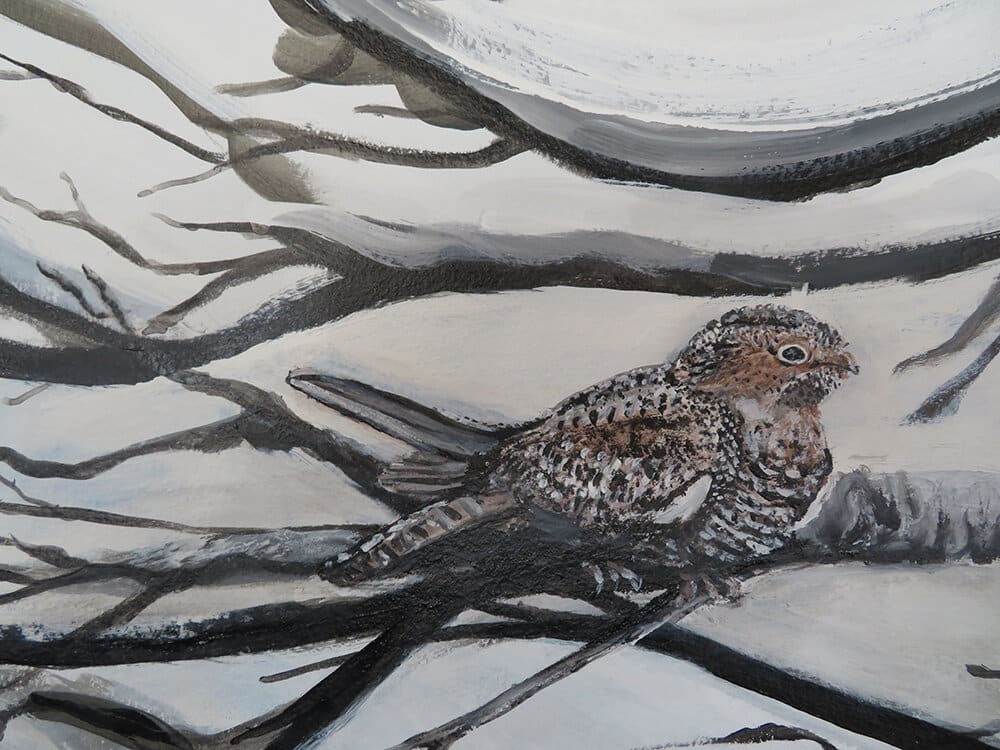
In the ambiguous area where the prison bars begin to morph into the trunks of birch trees, a vigilant bird is roosting in the thicket. Vargas painted the bird — a common nighthawk — realistically, but it’s also a symbol.
“Nighthawks are parole agents, policemen, corrections staff who come in when you’re not expecting them, in the middle of the night, banging on the door,” he said. “They search your house, go through everything, to see if you have any drugs, weapons, anything you’re not supposed to have.”
The comfort and shelter of the forest beckon, but hidden chains and trapdoors line the dangerous transitional zone.
Some of the twisting bars appear to be melting — or crying.
“There are a lot of tears in this part,” Vargas said. “Everything is coming down on you so quick. The parole agents want you to complete this and complete that. ‘Don’t do that, don’t go to bars, don’t hang out with your friends,’ even though the only people you may know are people who have been in prison, and it’s your community.”
As he acted out the drama embedded in the mural, a man waiting for his parole appointment watched with quiet fascination. When Vargas explained the tears, the man broke his long silence.
“Oh, so that’s what that is?”
“Yes, it’s very symbolic,” Vargas replied. The artist took a step to his right, closer to the promised land. “You’re getting closer. The trees aren’t bending as much. They’re more realistic.”
Vargas’ vision of paradise, complete with a waterfall and sylvan pond, is cleverly positioned at the far right, just above two drinking fountains.
“This is whatever you want to say is your peaceful place,” he said. “It could be your backyard, it could be a community park, it could be a sofa — anything you want it to be.”
Carving initials
The Ingham County Parole Office isn’t the most sociable space in town. You get your business done, get the day’s good or bad news and move on.
But people often approached Vargas to offer comments as he worked.
“They’d ask me, ‘Did you do this yourself?’” Vargas said. “All kinds of compliments would pour out.”
Vargas wasn’t sure his symbolic imagery would get the point across, but he found that people understood the story embedded in the art right away.
“People would point to different spots and say, ‘I know what that is, what this is,’” Vargas said.
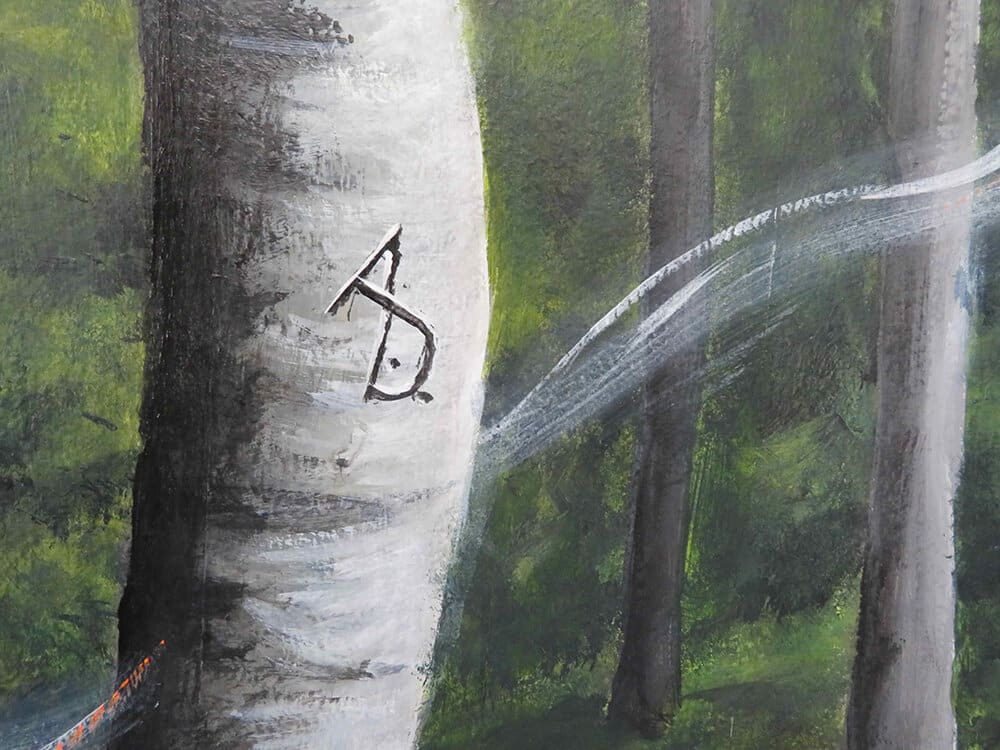
If the conversation was going well, Vargas would ask them where they would place themselves in the symbolic journey he mapped out on the wall. He “carved” their initials into the prison bars or tree trunks near the spot they pointed out.
Some of the stories he heard weren’t as hopeful as others. He talked with one parolee who had spent decades in prison and was finally on the outside, due to be fully discharged in six months.
He asked the man where he thought he was in the mural’s symbolic landscape, expecting him to point to the happy ending on the right.
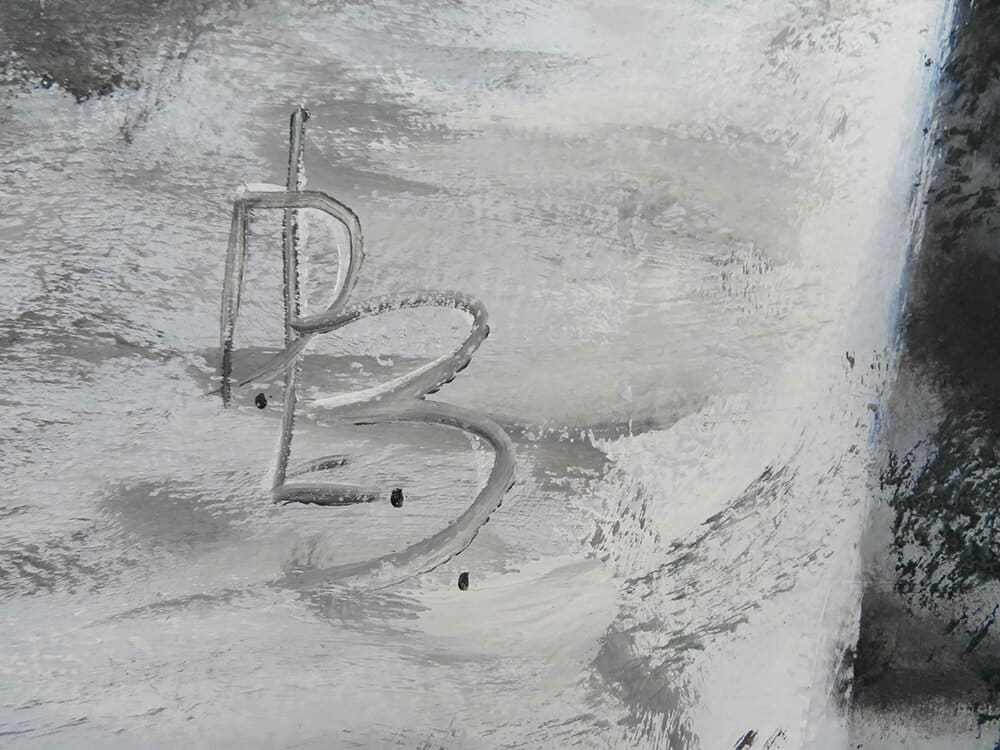
Instead, the man pointed to the darkest part of the prison cell.
“I don’t feel free,” he told Vargas. Yes, he was out of prison, but he was having trouble hanging on to his job and getting his bearings in a strange new world.
“Nobody out here remembers me,” the man explained. “My family and friends are all dead.”
It was a reminder to Vargas that not everyone has been able to come out of the maze and find their “peaceful place.”
“Even though you go through all this madness, this confusion, this chaos, you don’t see it in your head that peace and tranquility can be a part of your life,” he said.
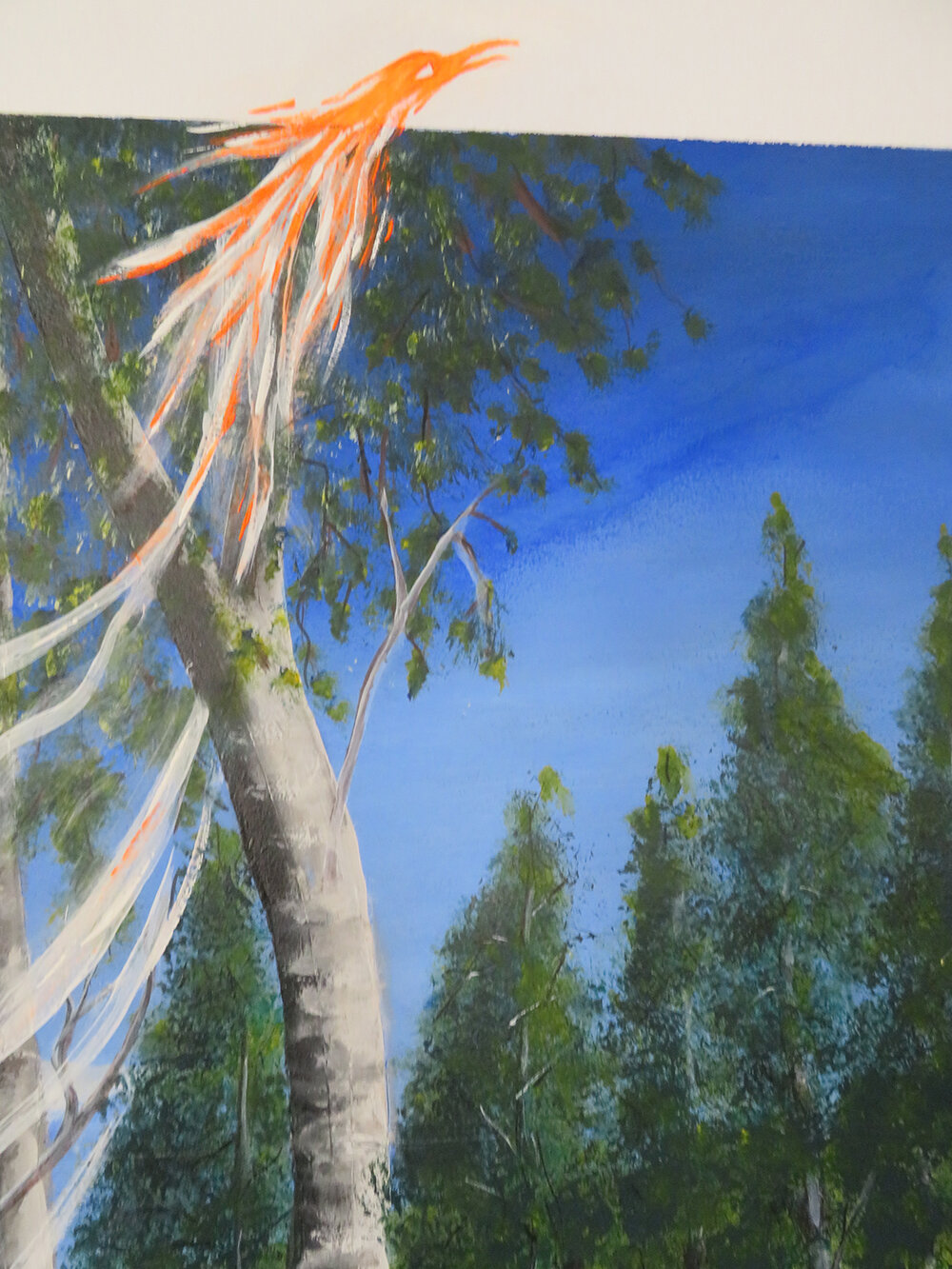
One of the last elements Vargas added to the mural is easy to miss: an orange, bird-like figure breaking through the top of the frame, out of the forest and onto the office wall above.
Vargas added the mythical symbol of rebirth, the phoenix, on his last day of painting to commemorate a fellow artist and parolee, Curtis Stevenson, who died in a car accident Oct. 9 at age 44.
“He successfully completed parole. He had the paperwork in his hand. Then a few days later, at two o’clock in the morning, speeding down the road, he wrapped himself around a tree and died,” Vargas said.
Stevenson and Vargas briefly collaborated on the mural in its early stages.
“He had a lot on his plate: court issues, family issues, parole issues,” Vargas said. “He wanted to do it, but he couldn’t commit, so I did the whole thing.”
They also had artistic disagreements. Stevenson wanted a bright orange phoenix somewhere in the mural, but Vargas didn’t think it would go with the design and color scheme. Stevenson also wanted to add elements outside the frame, and Vargas didn’t.
After Stevenson died, Vargas not only added an orange phoenix to the mural but painted it coming out of the frame and onto the wall, as Stevenson wanted.
“I felt bad about it,” Vargas said. “He was a good artist, and I really appreciated his friendship.”
A taste of art
When talk turns from his art to the details of his own life, Vargas reverts to his customary caution. He likes the word “avoid.”
He’s content to render his life experience on the wall in symbolic and universally understood visual language that other parolees can quietly share. He insists the journey is theirs, not only his.
“I want to live my life as I’m living it now, not as it was in the past,” he said. “I went to prison when I was 17 years old, following the biggest monster in the world: peer pressure. I was very much influenced by my peers to do something I wouldn’t do on my own. I learned that wasn’t me. The worst thing you ever did in life does not define you.”
He paused for a moment, pondering how much to add, how much to explain.
“In the past, I had no problem telling people what I did, how much time I did and who I used to hang out with because it was a part of my life then,” he said. “Now, if I were to talk about that, people wouldn’t see me for who I am now. They would see me for who I was then.”
He pointed to the darkest part of the mural.
“That brings me back here,” he said, “when, actually, I’m over here.” He swung his arm across the office, to the waterfall and the blue skies.
His interest in visual art was sparked, ironically, by a music class. Vargas was born in San Antonio in 1954, the second oldest of 13 kids. He went to a school “where you couldn’t speak Spanish on school grounds or you’d get whacked in the back of the head.”
There weren’t enough instruments for every kid, so the teacher suggested that Vargas fashion some drumsticks out of scrap wood at home and bring them to class.
He carved two drumsticks out of a broom handle.
“My mom was mad: ‘No, not my broomstick!’” he recalled. He dipped the drumsticks in white paint and watched the paint drip.
“For some reason, I was engrossed by that,” he said. “It looked like ice cream. I even tasted it.”
It was, literally, his first taste of art.
He spat it out, but he never lost his fascination with paint. He discovered a talent for drawing, painting and graphic art that made him unexpectedly popular. Friends, family and fellow students asked him to letter signs, design tattoos and make greeting cards. The greeting cards got bigger and more elaborate, with pullouts and foldouts.
“Art was a hustle for me,” he said. “I could do things other people couldn’t do.”
He had no problem creating graphics to order, but when someone asked him for “something to hang on the wall,” he was taken aback.
On the wall? That would be — well, art.
“I had no idea what to do,” he said. “It was a struggle.”
He picked up a pencil and drew a snowy egret crossing a stream.
“Next thing you know, I got all these compliments,” he said.
His artistic skills came in handy in prison as well.
“I could get cigarettes, food, marijuana, coffee, dope, books, shoes, anything,” he said. He got his first art supplies, a sketchpad and a set of pencils, from a deal he made in exchange for a drawing.
It took a while for Vargas to appreciate art’s potential to be more than just a hustle.
“I grew up in prison,” he said. “I didn’t like the environment, the people. I had to go through so many internal conversations. I spent months just looking at the ground. I’d look at myself in a water puddle and say, ‘Who am I? What do I want? This place is not me at all.’”
A mental escape hatch appeared quietly, without fanfare. When someone asked Vargas who he was and what he did, he found himself declaring, “I’m an artist.”
“When I gave myself that label, all of a sudden it clicked,” he said. “I liked that label. This is me. This is who I am. Eventually, I realized it wasn’t a hustle anymore. Art has enabled me to find a purpose in my life, to define my identity and to create good pieces of art that speak to a lot of people.”
Rise of the pudgies
The parole office mural is not Vargas’ first symbolic depiction of the parolee’s torturous journey. The other one is in the possession of U.S. Supreme Court Justice Sonia Sotomayor.
When Sotomayor came to speak at the University of Michigan in 2017, Aaron Dworkin, former dean of the School of Music, Theatre & Dance, asked Vargas to create an artwork to present to her.
“I was like, ‘Of course I can. I’m an artist, I can do anything,’” Vargas said, shaking his head at his own chutzpah. “But a week or so after that, I was like, ‘Why in the hell did I do that? Now what am I going to do?’”
He spent 235 hours painting a dizzying labyrinth of stairways and doors, in the manner of M.C. Escher. It takes sharp eyes to spot the artist’s own stick-like, stooping figure barely negotiating the maze. When Vargas got the call from Dworkin, he had already started the painting, but he took a break to read Sotomayor’s autobiography and found they shared some of the same challenges, especially in childhood. He included visual references to her life that he thought she would recognize.
Vargas treasures a photo on his phone of Sotomayor smiling broadly in front of the painting.
Over the years, Vargas has amassed a large portfolio that includes landscapes, portraits, still lifes and fantastic dragon-like creatures, rendered in his favored “photorealistic” style. The cover of the February 1998 “Prisons and Corrections” issue of the Michigan Bar Journal featured Vargas’ symbolic vision of a man cut into pieces, each piece floating in a bubble.
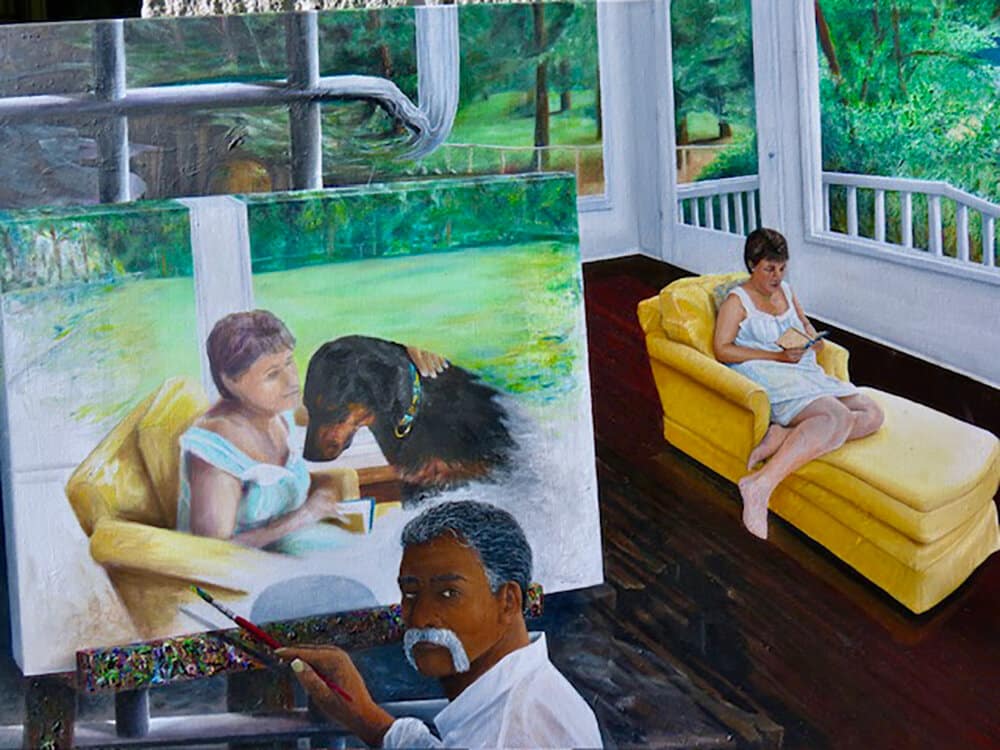
A triple portrait of himself, his wife and his dog in the sunroom of their home in Grand Ledge appears serene and ordered, but a closer look reveals traces of gray prison bars in the upper left-hand corner. He’s been married for 31 years to his wife, Barbara Levine Vargas, and has known her for 50 years.
Vargas has taken no classes or formal training, but he has read hundreds of how-to art books and was influenced by a Grand Rapids artist, the late Herschell Turner, whom he met in 1994.
“I saw him creating some great pieces with pastels, and I wanted to try to get these bright, striking colors you get with pastels,” Vargas said. “I tried it, and I flunked. I ended up with pastels all over the walls, my face.”
Turner urged him to stick with it.
“He taught me not to be scared of colors,” Vargas said. “Use them. They’re your friends.”
He struck a rich vein of originality while preparing a donation to a fundraiser for Mid-Michigan for Central America, a nonprofit raising funds to help Caribbean communities devastated in 1998 by monster Hurricane Mitch.
The deadline for the fundraiser was tight, so Vargas bypassed his usual realism in favor of thick, heavy figures that recall the work of Colombian artist and sculptor Fernando Botero.
“I remember reading a book about him, and I’m pretty sure it stuck in my head,” Vargas said.
He came up with 30 rough pastel sketches of plump, nearly featureless yet strangely charming figures caught in various forms of work and play. He told the nonprofit he would paint finished versions of the two or three they liked best in his usual realistic style.
To his surprise, they took the sketches as they were, blobby beings and all. All of them sold, raising considerable funds for the cause.
Vargas sensed he was on to something. He calls the figures “pudgies,” human forms that appear to have been sculpted roughly out of clay.
As the “pudgies” got more exposure, people contacted Vargas with all kinds of commissions.
“They’d ask for one playing basketball, walking dogs, gardening, biking, hiking, on a boat, in blue, in yellow,” he said.
It sounds like straight-up kitsch, but Vargas’ “pudgies” offer a profound commentary on what it means to be human. Utterly lacking in gender, race and other prejudicial signifiers — even clothes — they not only retain their individuality, but they short-circuit the viewer’s judgmental eye. You just root for them to do their own thing, be their own color, thrive and continue.
“They’re nude and come in all these different colors because there’s nothing threatening, nothing to judge,” Vargas said. “In an artist’s mind, I wish we could all feel safe, secure and comfortable with everybody.”
Letting go
As the afternoon of Oct. 15 dimmed to early evening, Vargas was ready to sign the mural. A parole office secretary maneuvered into position to immortalize the moment with her phone.
Callejas is slightly disappointed she can’t tease Vargas about finishing the mural anymore, but she’s already witnessed its positive impact on visitors.
“A lot of people ask who did it,” Callejas said. “When we say it’s someone who was inside, they say, ‘Oh.’ It resonates with most of the people who come here. We wanted to say, ‘Yes, you were inside, but now you’re out, and you have skills and abilities that you may have even used in prison. Let us support you and bring that out.’”
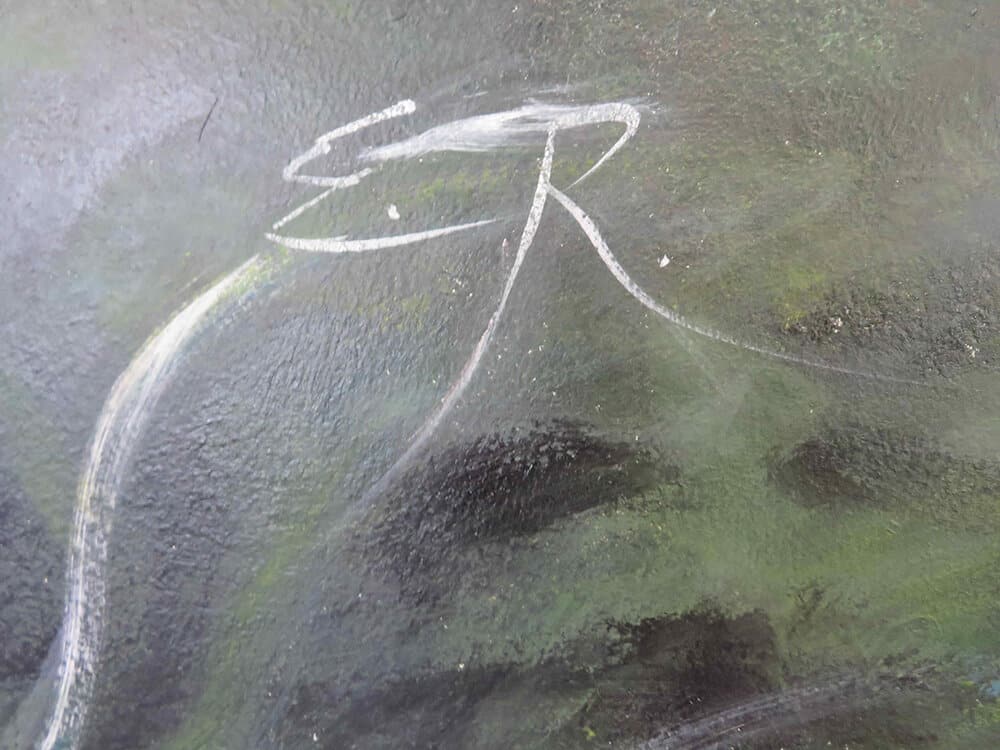
Vargas folded his lean frame next to the drinking fountain and signed the mural in bold black letters underneath the waterfall. He planned to return to the office one more time to inscribe the title, “Your Journey,” at the top of the mural.
He’s clearly proud of his work — and of another journey successfully completed — but from now on, this vision belongs to others.
“This is for that community, for the people sitting in those chairs,” Vargas said. “It’s not for me. They’re the ones who are actually going through this madness.”